
Season Two Episode Three
2.3 “Maybe the future of our writing lies in that weirdness”: Katina Rogers on her new book and the difficult beauty of critical hope
“. . . maybe embracing that weirdness and finding the spaces that are most uniquely human is how we can resist it in this moment where we don’t yet have a sense of what the full picture could look like.”
Katina Rogers
https://www.podbean.com/media/share/pb-t87u7-19f4d0c
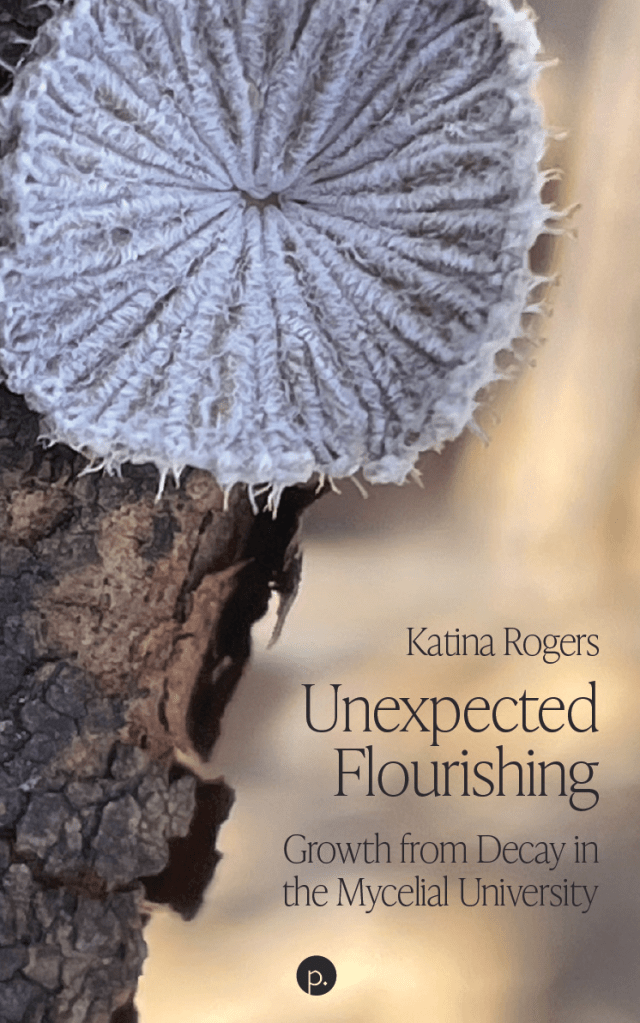
Katina Rogers describes the value of understanding the ecology of higher education as networks of care and possibility. Discussing her forthcoming book, “Unexpected Flourishing: Growth from Decay in the Mycelial University,” she considers the necessity of critical hope when we might be given to despair.
Transcript
| Quirky theme music plays in the background | |
| Katina |
What we see when we look at a rotting log could be, you know, something that is no longer alive. We can see a tree that has fallen, but we could also see the countless species that have now made that log their home. |
| Transitional theme music | |
| Lette |
“You can’t grow a mushroom,” Katina Rogers tells me near the end of our conversation, explaining the kind of growth that is independent of control – not following the sequences we might expect if we plant a seed, for example. I am Lette Bragg, and on this episode of Many Academies, we are talking about the critical hope of Katina’s forthcoming book, Unexpected Flourishing: Growth from Decay in the Mycelial University – an ecology of care, tracing the networks that sustained thinking and writing in the face of outbreak and higher education. |
| Lette |
At the beginning of our conversation, I call the kind of imagination that allows someone to place hope in these networks “anti-apocalyptic, gentle toward endings.” I’m trying to get at the reframe it takes to notice these networks of care. On our way to talking about that mushroom we can’t grow, though, we gather other metaphors and concepts that help us notice the forms of interconnection and relation that condition writing and thinking. How critical hope is that these forms of connection can offer us guidance when we ask ourselves, as we so often do: what do we do now? |
| Transitional theme music | |
| Lette |
I thought maybe to begin, you could tell us a bit about the title Growth and Decay in the Mycelial University. It’s beautiful. |
| Katina |
Thank you. And thank you so much for having me. This is a book that’s really special to me, and so I’m glad to have a chance to talk about it. Um, yeah, I see this book as fundamentally a hopeful book. And so I have been thinking a lot, I mean, the metaphor of mushrooms, and this kind of paired tension between growth and decay that I think we see a lot of when we think about the world of fungi and how they relate to the worlds of plants and animals and soil. |
| Katina |
But those two go hand in hand in that ecology. So as I’ve been thinking about universities, I kept coming back around to what I was learning in mycology and what I was seeing when I was out in the woods, and the hopefulness that comes from these moments that look like decay. And so in a moment when so much about higher education is not good, it has been an exercise for me to think about: where are the points where I do see hopefulness, and where I do see life and possibility and thriving? |
| Katina |
And so for me, the title is a way to keep that emphasis on: what do we do from here in order to thrive, in order to flourish, but without looking past and ignoring the challenges and the very real problems in the landscape as it currently exists. And so in an academic context, you know, we’re looking for enrollment, we’re looking for program growth, we’re looking for grants that have been received and papers that have been published. |
| Katina |
But it’s much harder sometimes to see, you know, the ways that students are supporting one another behind the scenes when they know that someone’s going through a difficult time, or the ways that faculty members come together in a pinch to find a way to keep a program going under adverse circumstances. And I think that there are, you know, in an ideal world, we would have structures that enable those things to happen organically, rather than those things having to happen in spite of the structures that are maybe oriented toward different types of success and different types of value structures. |
| Katina |
And so that’s where I land on the idea of this mycelial university. Mycelium is the underground body of a fungus. And most of the mass of what we think of as mushrooms is actually underground and not visible to the naked eye. And most of these mycelial strands, it’s almost like the roots of a plant. But most of them are only one cell wide, and they’re so densely packed in every square inch of soil that we’re walking on, but we don’t see it. |
| Katina |
And through this mycelium, there’s so much that’s happening. There’s nutrient acquisition from the soil into the body of the fungus, and there’s nutrient transfer between different species and even between different kingdoms across plants and mushrooms. And there’s restoration of the soil. As the fungi are decomposing the material around them that has died, they’re helping to return those dead leaves and that fallen log to become fertile soil again. So I wanted to find ways to think about those mycelial connections, those mycelial passageways, and what they might look like in the context of a university. |
| Transitional theme music | |
| Lette |
So preparing for this interview, and usually I’m, like, focused on the text and, like, writing down things, and then all your lovely images of mushrooms and fungi. I found myself, like, tracing the contours of them, right, in preparation, seeing where it would take my mind, how it would bend things. And then I was like, okay, I must turn the light down in the podcast studio. |
| Lette |
So I’m, like, more in the, you know, more in the gloom, and then, and kind of set and let things kind of break down a little bit, and then to kind of see what happens. And then I turn the lights back up, because I was like, no—because it is such a practice, this focus we have on building and progress and looking at given structures and the given infrastructure. There’s something really difficult about letting go of that and making time and space. |
| Katina |
So I, you know, there’s a tension for me in which I don’t want to get too far down a road of saying that, oh, these structures just don’t matter; we can just do away with them entirely. Because I do think that we, you know, there’s an important freedom that is found in the stability that a structure can provide through wages and job security and benefits. |
| Katina |
But what you say really resonates about, you know, tracing the patterns, about kind of letting yourself move more deeply into some of the visual parts of the book, too. And this was something that was very new to me in the project, and that has felt very significant to me in putting the book together, which is that it… The book incorporates quite a few photographs that I’ve taken, mostly around where I live in Brooklyn, but from other places as well – things that I found beautiful or interesting or strange. And another element of it, which was not in the manuscript version that you read but that will be in the final book, is that some of the segments that have a more personal tone are actually handwritten. |
| Katina |
And so, in the book, you’ll be able to see the movements of my body, really, in creating these different elements of the book. I wanted to find a way, I found that when I was writing it, it surprised me how difficult it was to bring together these different elements of my thinking: the academic training, the walks in the woods, and also my role as a parent and my role within the community. |
| Katina |
And yet all those things were really shaping the way that I was thinking. And it was very new to me to try and bring those together within a single space. And I found that typed words on the page were not quite enough. So the table of contents is something that I drew, and that I wanted to make, you know, non-linear, even though people will likely experience the book in a linear way. But somehow it felt important to me to have these traces of the physical and of other sensory experiences. You know, I can’t really get the smell of a mushroom into the book, but I can at least include what it looks like, and maybe what it sounded like to be walking in the woods that day. |
| Transitional theme music | |
| Lette |
You know, when I talk about writing, too, because I’ve noticed more and more we are becoming concerned with not erasing the processes that bring us to our ideas. You know, that final idea that we kind of land on that sinks through all the layers and the doubts and the worry and the avoidance, and it sinks through to the book – like how we come to those ideas, the kind of work that it takes is not smooth and clean and linear and expected. It’s really been a surprise, and it’s nice to keep that in the book. There’s something kind of ethical and real about it, and caring. |
| Katina |
One of the things that I thought about a lot while I was writing – and this connects to what you’re saying about process – I mean, I love the way that Katherine McKittrick engages with citations in some of her work, and I’m forgetting the title now; that’s what I was turning to look for, was her book. But in it, she keeps referring back to work by Sylvia Wynter. And at a certain point, you know, she has made a number of references already to Wynter’s work, and there’s one footnote, partway through the book, that simply named Sylvia Wynter over and over and over and over again. And I loved this so much because, to me, it was a way of showing not just the connection to a particular mode of thought, but the depth with which that person’s thinking had influenced a writer. |
| Katina |
And I’m sure that we all have these, right? The people and the works that we just keep turning to, almost like a worry stone in our pocket or something. We just keep going back to it and holding it and looking at it again in a different light. And how do we convey that in, you know, Chicago style? It’s hard to do that, to really get at the texture of what those influences look like. |
| Katina |
And that’s still within the realm of, like, academic references. It’s even harder to talk about how a conversation with a friend changed the way we thought about something in our work, or, you know, something else that maybe can’t even be put easily into language. McKittrick also includes a Spotify playlist that she was listening to while writing the book. And I love that too, because there’s so much about our writing processes that feel very private. And when we pick up a book, you know, there’s at once something that I think is really sacred about it, and something that is very disconnected from the writer who created it. |
| Katina |
And so to have all these windows into the writing process felt really lovely to me – just a really different way to think about how the book had come about. It has been interesting for me to see the ways my writing has changed in the years since I have started working outside of institutions. So I’m an independent scholar and consultant now, after having worked in public universities for a long time. And I found when I was no longer embedded within the university system and structure that there were some ways of thinking that loosened in my mind that I just had not really had access to prior to that. And, I mean, I think it’s worth saying, too, that I was not a faculty member at the university, and so research was not necessarily meant to be something that my role had space and time for. But still, I do think that, you know, again, this idea of progress – the kind of constant overwork that happens across many university spaces – is really antithetical to the spacious thinking that so many of us wanna be able to do. And so thinking, too, about, all right, how do we just hold space for that to be possible? |
| Katina |
It really feels like a luxury a lot of the time. I mean, one of the things that kind of led into the development of this book was: in early COVID lockdown stages, when I had first left my job at the City University of New York, I started gathering a group of people together for kind of monthly-ish reading group conversations. And we talked about things that were at least tangentially related to higher education, but often not totally directly related – things that enabled us to think about what was happening in universities at a little bit of a slant. |
| Katina |
And those spaces felt really significant to me because we didn’t have any funding, we didn’t have any mandate, we didn’t have anybody asking for anything from us as an outcome at the end. And so, on one hand, it was a space of privilege, right, that people had to have time in their day to be able to participate in something that was not part of their job. |
| Katina |
And at the same time, the benefit of that was that it was this set-aside space that did not have expectations on it, and where we could feel free to explore some different connections that might not come up in the context of something where a grant funder is waiting for a report or a department chair is waiting for an update. |
| Katina |
And so I think that, you know, along with the idea of this hidden mycelium and the connections that can be fostered there, there’s something important for me, too, in the work of just holding space, and who’s able to do that, and in what ways, and kind of the generosity of being able to help others to find that space in their own work. |
| Transitional theme music | |
| Lette |
It reminds me of your term critical hope, because on some level, you know, when we talk about higher education in the way that we do now, and we talk about these, like, set-aside spaces or these interstitial spaces, it’s almost the way that I get excited by a crack in the concrete and something grows there, you know? So I’m like, okay, the cracks, there are still cracks where things are growing. |
| Katina |
M-hmm, yeah, I love that metaphor, too. And it makes me think of an article by Natalie Loveless and Carrie Smith called “Attunement in the Cracks,” and it is about how relational this type of work is, that, you know, even to be able to find those spaces where something new emerges. |
| Katina |
It’s not happening in a vacuum. It’s not happening through one person’s force of will. It’s something complex that, like you said, is happening underneath what we can actually see to prepare the groundwork for that shoot to come up in the crack, or for the tree root to push up the sidewalk until it, you know, starts to crumble. |
| Katina |
So I think for me, too, thinking about what those relational elements are and how to bring those into focus, when those are not typically elements of scholarly work that are rewarded, is also something that can be quite challenging. |
| Transitional theme music | |
| Lette |
I wanted to go back to something else that you brought up, which was your passage through the academy and through higher education. Would you mind talking about that a little bit, and how you went from there to here? |
| Katina |
Sure. Yeah, it’s been interesting to look at my own pathway in the rearview mirror, because all the steps make sense when I look backwards. But I don’t know that they felt like they made sense when I was moving through them. |
| Lette |
No, yeah, completely. Yeah. |
| Katina |
I mean, I think a lot about graduate education, and I talk to a lot of graduate students. And one of the things I like asking people is what they were expecting when they went to grad school, what made them want to go to grad school in the first place. And when I think about that part of my own story, I was quite naïve about what it even meant to earn a PhD. |
| Katina |
It was a very unfamiliar space for me. I didn’t really even know that most people came in expecting to go on to a faculty career. And so I think because of that, I was never holding very tightly to that particular outcome. I just, I loved being able to continue to study, and it felt like a real luxury and a privilege. |
| Katina |
But I also found that I really enjoyed thinking about the systems and structures that underpin some of what makes that work possible. And I found that, you know, as much as I enjoyed teaching, in some ways it also never quite felt like a professional home for me. |
| Katina |
So I never went on the faculty job market, but I did look for positions that would allow me to continue, like, having a foot in academic space and maybe helping to make that space better, while also, you know, engaging with it in slightly different ways. So I worked at the Alfred P. Sloan Foundation when they were developing a new program around scholarly communication. I worked at the University of Virginia when they had a grant-funded program called the Scholarly Communication Institute. |
| Katina |
I worked at the Modern Language Association when they were first developing their MLA Commons platform for their members to have new ways to connect with and communicate with each other. And then I worked for the better part of a decade at CUNY Graduate Center, where I was co-directing a program that was trying to look really comprehensively at graduate education and how it sits within the educational ecosystem. Not just universities, but also the communities around us. Thinking not just about, you know, four-year colleges, but also about community colleges where most of our undergraduates go to school. |
| Katina |
Thinking about why the work we do matters and how we can develop systems that knit these structures together in more meaningful ways. And that work has felt really meaningful. I especially loved working at CUNY because it’s a place where both the faculty and the students and the staff are all very deeply mission-driven. |
| Katina |
Even in an environment of constant austerity, CUNY is always fighting for its budget. The system still manages to educate 500,000 students across all five boroughs of the city. And it’s remarkable to me, you know, that this still exists. I compare the CUNY system a lot to the University of Colorado system, which is where I earned my PhD. And Colorado has just stripped away so much public funding that it’s, you know, it’s receiving, I think, something like 3% of its revenue from the state at this point. |
| Katina |
It’s private in all but name only. It’s very expensive for people to attend. New York, for all of its challenges, has continued to ensure that students can get an education and not go into huge amounts of debt. It’s not easy, and students really hustle – graduate students included – but I have seen that, you know, New York still places value on the idea of a public good and the place that education holds within that. |
| Katina |
So I felt like I gained a lot of education from my time at CUNY. And then, COVID happened, and I found myself working with two small kids at home who were trying to, you know, go to Zoom kindergarten. And it was terrible the way it was terrible for so many of us, even though, you know, our family was lucky and had stability in lots of ways. |
| Katina |
I think I, like many other people, started to feel a shift in my relationship to work and the role that I wanted my work to have in my life, and the sense of agency that I wanted to have relative to that work. And so I decided to try stepping out on my own. And now I work mostly with universities, but also with nonprofits and some individual scholars all over the country, to help them on projects that they’re working on – whether it’s program evaluations or writing grants to be able to fund the work that they want to do. |
| Katina |
And I’ve been finding it really meaningful to be able to connect with people in so many different contexts, rather than have more of a laser focus in one particular place. That was a lot, sorry, but yeah, that’s been my pathway there. [laughs] |
| Transitional theme music | |
| Lette |
It was really great to hear. Like, you were talking about CUNY and how much you admire the way they fight to protect the programs and departments and spaces and spaces that are necessary for thinking. And I, too, like, I adore people with that kind of protective energy, that labor, that goes into keeping what’s there for others. |
| Lette |
And then there is this also, this capacity to let decay. And I found the term hospice that you brought up in your book – around “hospicing” as a verb – I found that really beautiful and useful as a framework to bring into visibility all the different kinds of care work we’re actually doing, even though we don’t fully understand it as such. |
| Katina |
M-hmm, And the care work is happening in those moments of hospice, too. And the term comes from a book called Hospicing Modernity. And I also have been thinking about it in relation to some completely different work that a friend of mine does. She’s a nurse in a cancer hospital, and she works a lot on end of life, not only with patients, but with their caregivers and their family members who are with them. And the amount of time and energy and care that she puts into thinking about these transitions from, you know, active treatment to end-of-life support is really powerful to me. |
| Katina |
Just thinking about, you know, that act of hospicing, of recognizing that something is winding down. Now, you know, shifting back to thinking about this in an academic context, but recognizing that something is winding down instead of trying to keep propping it up artificially forever can be an act of care as well. And that there’s, you know, there’s a kind of – I think this is not my term – graceful degradation: to be able to let something go in a way that is elegant and shows, you know, the care and beauty of wrapping something up in an attentive and mindful way. |
| Katina |
Rather than kind of keeping it going until it’s way past its prime, and then it sort of disappears off of the university website or whatever the case may be. And I think that, like, the relational aspect that you bring up is really important. There’s, I think, both the desire to sort of prop things up artificially and the desire not to let other people help us both come from this myth of self-reliance that we’re able to do things on our own. |
| Katina |
And I think letting go of that a little bit both can make it easier to let programs come and go in a way that’s maybe a bit more organic, but also be more willing to let people in, let people help, ask for help when we need it, show up for other people when they need it. |
| Katina |
I mean, and that’s what really creates this web of support, is that relational willingness to, you know, not just to talk to people and connect with people, but really to let ourselves be vulnerable and let ourselves be helped when we need to be helped. |
| Transitional theme music | |
| Lette |
When you look at the mycelial university, we’re also looking at a different temporality of thinking, or of understanding. You know, sometimes there is this fog, and there’s something beautiful there, and we can’t quite see it. |
| Katina |
And we don’t control it either. Sorry – we don’t control it within that temporality, that we can’t precipitate something to happen faster than it’s meant to happen. And I think this is also something that really drew me to mycology, was this sense of the unknown and the mysterious and the fact that, like, you can’t – you can’t grow a mushroom. Some mushrooms you can, but many mushrooms you can’t grow in the same way that you would plant a seed and have a very expected sequence of what happens next. |
| Katina |
It just doesn’t work like that. And so I think that unexpectedness – the sense that you could walk by a spot in the woods one day and there’s nothing there, walk by a day later and the conditions have changed, and there’s, you know, this beautiful little mushroom popping up. It’s something that I really love, too. |
| Lette |
Yeah, I love the out-of-control things that happen without me even knowing they could be possible. I endure it, and very often it has, like, nothing to do with me. Like I had nothing to do with that beauty. And there is! |
| Transitional theme music | |
| Lette |
So let’s close off, then, by talking about writing. You were invited to a roundtable by Punctum Book’s co-director, Eileen Fradenburg Joy to talk about open access and knowledge production. It was during Open Access Week. And the theme of the week was: who owns our knowledge? Do we own our knowledge? |
| Lette |
And we were talking at one point about AI. And it’s such a huge issue for me, like, so many of the problems that we face now are just so huge. I can barely see the end of them, and when I can’t see the end of something, it’s hard for me to, you know, figure out the appropriate response, because I’m like, what am I responding to? |
| Lette |
And reading your book was really helpful to me because of the textured world it was giving me, and I found something there to protect. Is there something about the way we write, that we think it has to be smooth to be good? And very often it’s the textured, the moments where we, like, stumble, you know, where the beauty lie. |
| Katina |
Yeah, I would love to. And I was so sorry to miss that panel and that conversation. I think it was in a column that Tressie McMillan Cottom wrote about AI in The New York Times not too long ago, where she writes that, you know, one of the things that is the greatest loss as we start outsourcing more and more of our writing to AI is the weirdness of human writing and the unexpected directions that things can take, the unexpected connections. |
| Katina |
And it’s true, you know, things that are written by generative AI have a smoothness to them. They have a flatness to them, I think that just eliminates all of those surface bumps, all those unexpected twists and turns. And it gives me a new appreciation for the writers that can surprise me, the writers whose work goes in directions that I did not see coming, because more and more of that sort of linear progression of writing is something that is accessible in other ways, in other spaces, and in ways and spaces that don’t necessarily feel good and ethical. So, yeah, I mean, maybe the future of our writing lies in that weirdness. I think that would be great. It would be a pleasure, from I think a reading experience, to see writers lean into kind of the strange elements of their own work and the things that make their work uniquely theirs. It was a challenge for me in this book. I’ve never let myself write in quite such a braided way, with different elements of myself and also, you know, different styles of the writing. And it was interesting to me to see how hard it can be to unlearn some of the habits of academic writing too, in trying to loosen what that structure actually looks like. So, yeah, I don’t know. I appreciate what you’re saying about not being able to see the contours yet, which makes it really hard to respond. I think that hits on something that feels really important right now. It feels like this sort of huge looming cloud moving towards us, and it’s hard to know exactly what element of it to even engage with. And so, yeah, I mean, maybe embracing that weirdness and finding the spaces that are most uniquely human is how we can resist it in this moment where we don’t yet have a sense of what the full picture could look like. |
| Transitional theme music | |
| Lette |
As we spoke, we didn’t have immediately to hand the names of the authors and texts helping us make sense of things. These included Dear Science by Katherine McKittrick, Hospicing Modernity by Vanessa Machado de Oliveira, and Easy Beauty by Chloé Cooper Jones. You can find links to these in the podcast’s website, where you can also find a transcript for this episode and a link to Unexpected Flourishing, which is forthcoming in summer 2026 from Penguin Books. |
| Lette |
Thank you to Katina Rogers for this episode in conversation. Thank you to Jodie Riddex for the art and Sebastian Bauer for the music. Thank you for listening. |
Podcast also available on Apple Podcasts and RSS.
 Many Academies