
Season Two Episode Four
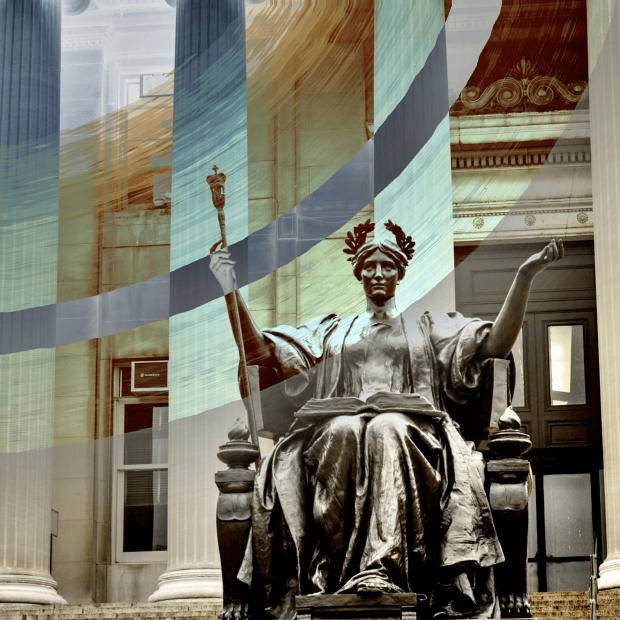
Gil Anidjar attends to the persistence of the phrase, “Alma Mater,” considering what it helps us to see about the place and role of the university in politics and the reproduction and perdurance of our world.
This episode is also available for streaming on PodBean.
Transcript
| Quirky theme music plays in the background | |
| Gil |
What if the university were a mother, as we call it, as we call it? And what if, what if we asked of it to be true to that notion? And what might that mean? |
| Lette |
I am Lette Bragg, host of Many Academies. I’m talking today with Gil Anidjar, professor of religion at Columbia University, about the four-part intervention he recently published in Arcade, the open-access digital forum sponsored by the Stanford Humanities Center. The piece—and as I ask, is it a jeremiad?—is called Alma Mater (The University at War), and it is an autocritique of the university that embraces the intimacy of this name. Beloved mother, reaching for a response to our dystopian crises: it meets our urgency. Can the university save the world? Well, I know that our losses and challenges are not easily disentangled. I first ask you about the occasion of this autocritique—which is the emergency of this intervention? After this—I’m not expecting to close the question—we consider the possibilities of perdurance, the condition of fragmentation, and how to act in concert, just as mothers have always had to do. |
| Gil |
That’s a great question. I just wanna say something about the jeremiad. I didn’t think of myself as writing in this genre, although I do know that I’m, you know, I’m very taken still by the so-called prophetic tradition. And there is something about, about trying. Yes. And it’s so very hard today because our own sense of truth and fiction, truth and lies is, I think, so confused. And confused, speaking of autocritique, because of our own, or I think I can speak in the “overall,” because a number of us have been raised more or less on this notion, the Nietzschean notion that truth is but an army of metaphors. And, and that once we, and now that we are so openly confronted with so many lies and so many technologies of lying, we seem to want to go back, as it were, right? As progressives, we want to go back to a time when truth actually meant something. And I write with a very intense sense that an appeal to truth is not gonna do it anymore. Because we ourselves participated in the kind of, I don’t know, a delusion or demystification of the notion of truth, which makes it very hard for us now to appeal to truth, or to facts. And that, again, is not only our doing. It’s just, I don’t think we recognized much a part of the zeitgeist we were. It’s just that the zeitgeist has taken us to a different direction than we thought. So that’s for the jeremiad, if I may, you know, who is us, who have lost truth, and who still want to appeal to, to something like that. With regard to the emergency: one of the things that has struck me, I think, you know, I’ve been living in the company of this scary figure named Carl Schmitt, who defined sovereignty as the decision of the exception, and with some debates as to whether the exception and the emergency is two different things. We don’t need to get into that. But one of the things which Schmitt, which he has also with regard to the enemy is that, he only wants one—one enemy, one emergency. The sovereign decides on the exception, on the emergency. And it seems so very obvious today that we are dealing with so many emergencies, so many urgencies. And we, we seem, um, to be capable of engaging with—if I’m making it this way—our own: we have our sense of where we are mobilized and where we want to agitate. And yet we are deeply, deeply aware of the fact that there are other emergencies, and also the fact that we might need to figure out what is the connection between this emergency and that emergency. So, to take a not-so-random example: is Palestine about the environment? Is Palestine a symptom of the environment? Yes, one might think of water or of fossil fuel. Or is it the other way around? Or are these two different emergencies, and we should simply divide our labor and recognize that some of us are capable of doing this, and some of us are capable of doing that? Now, I don’t know where it comes from for me, that notion that the university is the place where the possibility of the knowledge that would guide us with regard to those different emergencies, should come from? It seems to be well located to, to not adjudicate, but one might say advise or teach. What are the connections between the different emergencies and what priorities we should have? Yes. You know, when I read about trauma in Didier Fassin and Richard Rechtman’s book on trauma, one of the things they described is that now, when there’s a volcano that is about to erupt, the first responders before the explosion are, for the most part, psychiatrists and psychologists. So, we understand the emergency as a psychic emergency, which is interesting because it is meant to prevent trauma, but not to prevent the explosion. Yes. Not to deal with anything else that we might need—seismologists, for example, one might think. Yes. And yet there is no authority, there is no sovereignty, there is no site that adjudicates. And so, like: no, I think we are fine with the therapist for now. We might need a few more police. We might need, you know, I don’t know, fire extinguishers, something of the sort. Yes. And the fact that the university has not positioned itself as a site where, for example, where things are being said about the state of education or the state of the economy, yes, from all kinds of sources, the university might say: actually, this is something where we can contribute. There are those who say this. There are those who say that. But the truth of the matter is more likely to be that or that. It’s a place of knowledge, and that knowledge is already gathered in one place. And yet it is, right, I mean, I think I can drop the mask now—it is obviously absolutely not what the university is doing. Most of us are located in disciplines. Most of us are located in our schools, and the lawyers are being lawyers or jurists, and the engineers are being engineers. And yes, there are some, you know, data-and-society kind of endeavors, but it doesn’t seem like it’s the university at work as much as a kind of negotiation with market forces and perhaps some necessities that are not, not scholarly. Yes. So that was the thinking. I wanted, at some point, I’m really not the person to do this—but I wanted to bring engineers and lawyers and, and literature people and religion and politics and bring them together and ask: so you engineers, what do you think about the teaching of literature at the university? Do you think this is part of the way the world should look? Is this something that is important? And do you want to ask us humanities people: what do we think about the development of AI? I know that those conversations are not happening. Yes, but it feels like this should happen institutionally and not just—well, I’m interested and I’m doing interdisciplinary work. Yes. Or I happen to get funding from the whatever NEH to do this and that. As an institution to mobilize its resources and speak—provide roadmaps, different roadmaps, but roadmaps. |
| Transitional theme music | |
| Lette |
Yeah. And I see that coming through in Alma Mater. And hearing you talk, it’s the loss, um, the loss that we’re facing, like the emergency, the stakes of what we’re confronting. On the one hand, you were talking earlier about the loss of truth. You know, this is what we’re living with: the loss of truth. And I love this phrase you had, “the technology of lies.” Alma Mater also seems to be confronting the possibility of—or the loss of the possibility of—politics. And so what Alma Mater does is it looks to the university as a site of politics and education and reframes it in terms of the university as a mother, as a way, yeah, as a way to rethink sovereignty, rethink education. So I thought: yeah, this idea of the university as a site of politics and what that means for you, and then how the mother—the alma mater—fits into this. |
| Gil |
Right. I think one of the things that was striking to me was, first of all, the paucity of an extended discussion on that most popular of names of the university: alma mater. I’m still very much struggling with this. One, because of course I’m worried about metaphorization. Yes. But, um, you know, because I’ve read, like you, perhaps too much Derrida, I’m never quite sure what is literal and what is metaphorical, and the fact that the metaphorical also very much informs the literal. But one of the things that I keep thinking about is that—and this was the part about more than one mother—is that no mother can afford to ignore the world: the negotiation with the world. Even if the world is abandoning the mother, the negotiation is constant. “Negotiation” is, of course, the soft word for a situation that might be excruciatingly painful. Yes. But there is a constant give and take. And no mother can say: but I’m not going to teach my children language. Yes. I’m not gonna teach them how to behave in the world. I’m not going to prepare them for the world. Now, some of us do this better than others, but the program is absolute and non-negotiable. In fact, now, if the university were a mother, it could not afford to ignore the world. It is not a question of the university is absolutely not an ivory tower. I completely disagree with that notion that we are disconnected. We’re not disconnected. We are simply positioned in the world in a particular way. And yes, there’s a suspension of disbelief, as it were, that it is necessary to engage in scholarly questioning. But, um, we are very much in the world and we are informed by it. We are responding to it. We are curious of it. And so is the university as a whole. But the way in which it practices that interaction and that non-negotiability—I want to ask, you know, there is such a thing as a good-enough mother, but I am not certain that if the university is a mother, that it is, in fact, quite, quite, not quite good enough in relation to its responsibility. Yes. And I, as I was writing this piece, I was really quite shocked to find that even the word “alum”, yes, it resonates with “alma.” Yeah. And it has to do with the nursing, the amount of maternal language that we actually carry, is quite extraordinary. And I just, you know, it never hit me. And once you do that it is quite obvious. And yet, so what if the university were a mother, right, as again, as we call it anyway. |
| Transitional theme music | |
| Lette |
When you talk about the university as a mother, you’re not talking about questions of socialization, you’re not talking about questions of beginnings. So there’s all the ways maternity, like in its metaphors, in the way it’s represented in our narratives, it’s often about birth. Right? It’s often about origins and genesis, and reproduction. You use “reproduction” in a very particular way that we must talk about, because that’s what’s critical to this new political model. Right? It’s this sense of reproduction, right? It really is something about worlding. Right? It’s like something about an inscribing a world. |
| Gil |
Right? I mean, I think it is a question of, as it were, prioritizing, because I don’t mean to say an absolute not to those things, because they are there and they are necessary in different ways. But it is, but you’re absolutely right that I’m trying to give the word “reproduction” a different sense, which has to do with the preservation and the duration of time. Of time and of the collective—a collective is not—there are collectives that are ephemeral. There are collectives that, like the famous commercial contract, which regulate so much of our existence. And yet, as a collective, we are projecting ourselves onto the future, and we are busying ourselves with the future. The future of us. Not a future into which we want to arrive, but rather our own duration. And to, right. And I summarize this in this Heideggerian phrase, “mothers and time,” that what mothers do not only takes time but, in fact, make time. It makes the duration of the, we can call it the family, we can call it the society, we can call it the polity. It makes it last. All those activities that reproduce a ritual, a law, a habit, a series of fashions, and that inscribe within us that which we want to, or choose to, or unwittingly, present. Right. It doesn’t have to be a conscious activity. The unconscious is a major part of this. But we are perduring. And insofar as we perdure, there are activities, inscriptions that are necessary. And I want to include within the maternal everything that makes the polity itself perdure. And so the role of the university, I almost want to say: if we are going to advocate for the perdurance of that institution that is already an old institution, and perhaps its time has passed, I don’t know, it has happened before that institutions pass on from the world. But if it wants to advocate for itself, it is so striking to me that it doesn’t make that particular argument: that it is essential that education, the fact that the university, as an institution, which recently decided that it shouldn’t involve itself in politics. Right. An extraordinary statement in itself. But the fact that, as an institution, the university has not spoken about the state of education in this country, that it prides itself, in the case of my institution, in its extraordinary rate of admission, yes, but doesn’t actually speak to what the state of education, from which it draws those extraordinary students, what the state of schools are, is a failure of maternality. Yes. It’s a complete failure of maternality. And it has nothing to do with corporations. It’s not about corporatization. It’s about a social vision and political vision that the university apparently doesn’t have. And yet it’s strange: we want the best students, but we don’t care what the state of the schools are in this country? And university cannot stick to that. We have to wait for politicians to tell us that charter schools are the best way to go. |
| Transitional theme music | |
| Lette |
I think people, when they face this, are often thinking: do I leave or do I stay? You know, but that’s never the question of a mother. It’s the world, it’s the thing, you know? |
| Gil |
Absolutely. And to go back to this really great question you asked me at first, namely, what is the emergency of the university? I do not claim to know what the emergency is. I know that the university could rise to the occasion and address the emergency and clarify the emergency, rather than, which perhaps, just seems to me that that’s what I’m, what I’m hearing a lot is: we must protect the university. And again, it’s striking to me that the conservatives have become revolutionaries and progressives have become conservatives. We try now, we call ourselves progressives, we want to preserve. We want to conserve what we had. Can we please keep the university? Can we please keep the courts? Can we please keep democracy? And yes, of course we should. But it is also that we should recognize what we have been part of, what it is that we have preserved, what it is that we have reproduced, and ask: well, is it time perhaps to rethink that? Because, yes, we do preserve, we do reproduce. But then the question is: what? And if what we reproduce are financial officers, yes, CFOs and CEOs of many kinds, then, you know, someone was telling me that, it was a few years ago, but something like 50% of undergraduates at Columbia were going into finance. Right, And rather than say what I’ve been myself saying for years. Oh, well, you know, we can get them to read a piece of literature, recognize what it is that we are participating in. And not so much: well, they don’t take our courses, but rather that we appear to be helping, and again participating in, the reproductive activity as an institution of which we are definitely a part. And again, I never tried to convince anybody in the business school, they’re my neighbors, they’re my colleagues. I’ve never tried to talk to them, let alone talk outside. Yes, we talk about the ivory tower as if we should be talking to the public outside. But we’re not talking to our colleague engineers and colleagues businesspeople. And I’m not suggesting that it’s only on us. Right. They’re not talking to us either. |
| Quirky theme music plays in the background | |
| Lette |
Now, when you were talking about Alma Mater, when you were comparing progressive and conservative views in relation to institutions, your language reminded me very much of Sylvia Wynter when she’s quoting Stafford Beer. Yeah. And she says something like, we cannot any longer cling to vanished worlds. We have to find a way to abandon vanished worlds. Right, and vanish categories and vanish institutions. And so this seemed to be something that you were thinking about yourself. No? |
| Gil |
It’s so interesting because, you know, affinities being what they are, I want to say yes. Yes. And yet, because I’ve been wondering about the temporality of the apocalypse. Yes. So many of us think that, you know, I had a friend and we used to discuss the meaning of the apocalypse. And one of the questions was always: yes, but is apocalypse ahead of us, or is it, in fact. as we know, yes, all we have to say is the Americas, for example, to recognize that the apocalypse is also behind us and that we are in its aftermath. But the question of temporality, for me, makes it such that. I—I’m trying to write something about the discipline of history these days, and one of the things that I repeat to myself, like a mantra, is: our relation to the past is not reducible to history as a discipline. It shouldn’t really not be that complicated. Yes. That what historians do, in terms of the way they deal with the past, is certainly a relation. Yes. But we, and I’m very inspired by Michel-Rolph Trouillot on that—that history is being written and practiced and said in many, many other sites, many other sites. And so it’s not enough to say people don’t care about history. Yes, people very much care about history—only it’s not necessarily the history of historians. It’s not the accurate history. So I don’t know what has vanished. I also—I’m certainly not in that way a prophet. I do not know what’s going to happen and I don’t pretend to know. But I look at what is around us, right, like a word like “alma,” like a phrase like “alma mater,” and it’s still here. And most of us we are like: woah Latin. I mean, who knows Latin anyway? And who cares? And what an antiquated idea. And anyway, where does that come from? We don’t even know. Yes, something like that. And yet, something persists. Something persists. And I don’t know what it is. I don’t know what gives it its force. I don’t know what promise it still holds. And so I think that I want to remain attentive. That is really all I do. That’s why I’m a reader. I’m a philologist in the sense that I try to be attentive to the text that is laid out in front of me. And I don’t presume, I mean, I could do source criticism and say: oh, well, but this is an older source that was recycled into that dadada. Or I can say: well, this is all in front of me. And yes, I can feel time moving in front of me. I myself move through time. I think I’m convinced I’m not born in the right time. But this is where I am, and so I negotiate that movement. And I want to say, actually, someone recently told me that she read my book, and she told me it sounds like a book written by her daughter. And I was like, wow. Yeah. I mean, I don’t know that I deserve the compliment, but I was ecstatic, obviously. But it also made me think that part of the issue of when does one stop being a mother, right? When is one on our way to mothering is also a question of temporality that cannot be resolved by history. “Well, I became a mother when my child was born.” Yes, but also no. Yes, it’s much more complicated. It depends a lot on your mother and on her mother, etc., etc. Yes, there are all kinds of temporalities that are at play. And so I wish I felt as secure in saying like: we need to let go of vanished worlds. But I don’t know what has vanished. I don’t know what is coming. I barely know where I am, yes, and where we are. It’s easy to say we are in the moment of transition. And mothering is not, it’s not living in the time of transition. But, and I don’t mean to be, you know, facile about this, but we should, we should, and perhaps this is the way I remain French. Yes. And “la vie est bricolage” is something that speaks to me still. Like: we’re making do with what we have. |
| Transitional theme music | |
| Lette |
You can’t make sense of the world, but you can attend to what is in front of you. And that is part of the way reproduction happens. And, but it also seems to be, I don’t know, that seems to be the impossible task. You know, I teach my students, they seem to want me to be able to make sense of the world. And I always, you know, because I teach a writing class, it’s composition, to me that’s outside of content. It’s about thinking, you know, it’s outside of know-how. It’s about attention. And I always have to begin the class by saying: well, I don’t know how to make sense of the world, so I don’t know what is the right thing to do in this moment, which is the question of the divisions, too. Who is thinking about the right thing to do at the moment, who is able to make sense of the world? This seems to be such, it’s such an impossible task. Right. |
| Gil |
So I think I hear you. I think that part of the issue, and this is why I’m so hesitant to speak about subjectivity, although I know it’s a very important word, and, you know, “subjectivity,” “subjectivation”… And I think that it may not be fair, but it feels to me so much that it’s a lingering individualism, which by now is so demonstrably intolerable and unsustainable. But again: the most alone mother is abandoned by the world. And that’s the way the world is present. Right? So, the mother is alone and yet also overwhelmed by a presence that practices an absence, practices abandonment. Yes. Otherwise the world would be a place of nourishment, a place of resources, a place of assistance, a place of collaboration, etc., etc. Um, yes, the world is there, right? I’m thirsty. There is water. Um. If there is not water, it doesn’t mean there is no world. It means the world has abandoned me and no longer provides me with water. But it doesn’t make the world an absence. It makes the world a negative presence, a harmful presence, right? Microplastics and etc. It is not that we are without world. It’s that the world we are with is noxious. So to be in the world means to recognize that we need the world. Otherwise I am nothing. I am a part of a network of the ways of the world—literally the ways. Yes, the path of the world. The best I can do—the way I resolve that, if I may call it distress—is: I can’t tell you how to make sense of the world. And I certainly cannot help you think a future that is yours, right, speaking to students. The one thing I can do is show you how people have made sense of the world. Not because they were great individuals, but because they were at the crossroads of worlds and of the worlds within which they were living. You know, it’s funny because I teach this great course, right, CC, it’s called the Core Curriculum: Contemporary Civilization. Another great use of language: from Plato to NATO is “contemporary civilization.” But I think one of the texts keeps surprising me, and I read them a number of times. I think the text that is still very much in front of me because of the way it fascinates me is Adam Smith. And totally unexpected for me. But The Wealth of Nations is such an amazing way of making sense of the world. Every fiber of my being wants to go like: not this way. And yet it articulates, right. I started quoting, Descartes says “I think, therefore I am,” Locke says “I own, therefore I am,” and Smith says “I exchange, therefore I am.” And that, to me, is a fundamentally different way of relating, because I may be the richest person on earth, but if no one wants to buy what I have, I will have nothing. And so Smith is actually thinking already, kind of, in Levinas, in terms of an indispensable other. And again, I don’t want to put it at that level of the commercial, right, and the foregrounding of the commercial, but the foregrounding of the relationship and the relations of dependence. This is not autonomy at all. It’s political economy as dependence. And to recognize that dependence is a way of making sense of the world. And the failures of Descartes—right, to take an easy target—as opposed to a certain recognition in Smith, for that matter, Babel, the Bible, etc. Yes. Those texts that make sense of the world in terms of the richness of the world also attempt at reducing that richness, by excluding all kinds of things, rejecting all kinds of things. But even in rejection, an inscription of that which is rejected. Right. My favorite commandment in the Bible is: erase the memory of Amalek. And this is written in a text that cannot be erased. In other words, the memory of Amalek is preserved forever under the figure of its erasure. It’s the best commandment ever. I mean, it’s the scariest commandment, but it’s the best commandment. It’s like I’m telling you to forget what I’m reminding you of forever and ever. So something about that, to me, is the way in which I try to unburden myself of, like: I have to do it. Yes, I have to do it all, and yet I can’t. And not recognizing that I cannot do it alone. And that if I am truly alone, it will not happen. Then, then it’s, as they say, the beginning of wisdom. We should be in this as a collective. And we are successful, less successful, again, reproducing all kinds of things. But what we are reproducing is, I think, the question, right. I mean, let’s say, I’m not entirely convinced that what we have been reproducing is democracy. Or if it is, we haven’t been doing such a great job of it. “Training the leaders of tomorrow,” yes? Not exactly a democratic phrase: “the leaders of tomorrow.” |
| Transitional theme music | |
| Lette |
I’m starting to get a better idea about what you mean about, when you describe maternity as inscribing the world on children and inscribing children onto the world. This inscription, it’s kind of, if the world is, if you’re being borne by the world, or the world is bearing you. There’s this move. If there’s this unbearability, we could say, there’s this move of inscription. That is what allows things to stay through time, right? A necessary inscription that’s coming from the potential loss or the potential abandonment. Right. Is that close to how you mean it—this idea of inscription? |
| Gil |
Absolutely, absolutely. The decision to raise one child, for an immigrant, yes, the ultimate figure of authority these days. To raise one child in the of in the place, as opposed to the language that one carries, it’s a decision that people make every day. Yes. But what will perdure is obviously very different. It’s a decision that can be completely thoughtless, like, well, obviously we need to do that school, or, we cannot do it. Or, right. It doesn’t have to be pondered for forever. But it’s a decision, and it’s a decision of perdurance and abandonment. Regardless, now, should traditions be preserved or should we remain who we are… All these are secondary to what maternity involves, which is a selection: we’re going to use that, we’re not going to use that; and therefore this is going to be inscribed and this is not. Right. I’m not fundamentally saying anything other than what Judith Butler already said when they said: it’s a boy—one time, two times, three times—until the repetition is automatic. That inscription is so much bigger, if I may, so much bigger than gender, so much more complex—and again, not only by one institution but by many. So it’s also not about privileging the university. It’s only that it is, practically, as it were, at a particular juncture. Right. It has located itself at a particular juncture within society, and we can evaluate it on that basis. |
| Lette |
So I know we’re at time. The last thing that occurred to me—you know, because I began by asking what was the urgency, what was the emergency, or what are the things we’re facing, the loss that we’re facing—and then now I’m wondering if for you it’s like time, like the sense of moving through time is something that we face losing, right? If we aren’t able to practice this repetition of worlds. |
| Gil |
I think that’s great. I think. And thank you for noticing the importance of the word “concert,” and “disconcert.” Because I think that the fragmentation, which I feel very much as also internal, right. It’s this thing about datafication, right? Like Amazon doesn’t care that I exist. It only cares that I share, you know, my love of whatever yoga mats and cotton pants with certain groups. Right. In other words, this is no longer racialization. We are part of groups that we completely ignore because we share things with that and with that group. And we are fragmented within ourselves. But we are also fragmented amongst ourselves. Right. And it’s only a question of time, in fact, until we find out: oh, I was with you on this, but no more. Now that you have come out as, you know, being, I don’t know, for veganism, then I think you’re going too far. Yes, whatever the line is. The lines of fight are no longer flight. We diminish our connections. And it feels very much like we are in the moment where the question of concerted action, other than, you know, swarm intelligence, which is the effect of social media, I don’t know. And so where is the swarm going at this point? It is a huge question. But I don’t think it’s coming out of individuals. I don’t really believe that influencers are individuals. They are something else. Right? Cedric Robinson, by the way, has drawn my mind, because he keeps saying we need a theory of followership, and we are all followers. Yeah, yeah, we need a theory of followership. And I think this is, all we can hope is that we are following together somewhere rather than us as isolated fragments. |
| Transitional theme music | |
| Lette |
Thank you, Gil Anidjar, for this conversation—the second of many, I hope. Thank you to Jodie for the art and Sebastian Bauer for the music. Thank you to the Aydelotte Foundation and to Swarthmore College for the support. And thank you for listening. |
 Many Academies